FITGIRL / Ingredient library
Creatine monohydrate
Content reviewed:
Ingredient information is not a product efficacy study. A publication, traditional use or a link to an ingredient does not authorise a health claim. [4]
Identity & classification
A crystalline compound of creatine and one water molecule. Creatine is not a protein; monohydrate weight and creatine weight are different quantities. [1] [2] [3]
Natural origin
Creatine occurs in animal foods and is also synthesised in the body. Commercial monohydrate is commonly produced by chemical synthesis rather than extracted from meat. [1] [2] [3]
History & background
Monohydrate is the established reference form in much of the sports-nutrition research. Other chemical forms should not be assumed equivalent. [1] [2] [3]
Production methods
One documented industrial route reacts sarcosinate with cyanamide, followed by crystallisation, purification and drying. Micronisation reduces particle size. This is a general example, not identification of FitGirl’s supplier or process. [1] [2] [3]
FitGirl raw material: the supplier, country of origin, batch specification and manufacturing process have not been independently verified. General production methods below do not establish the origin of this product.
Nutritional properties
Pure monohydrate contains approximately 87.9% creatine by molecular mass. Thus 5 g monohydrate corresponds theoretically to about 4.4 g creatine; this calculation is not a purity test. [1] [2] [3]
Food & sports nutrition
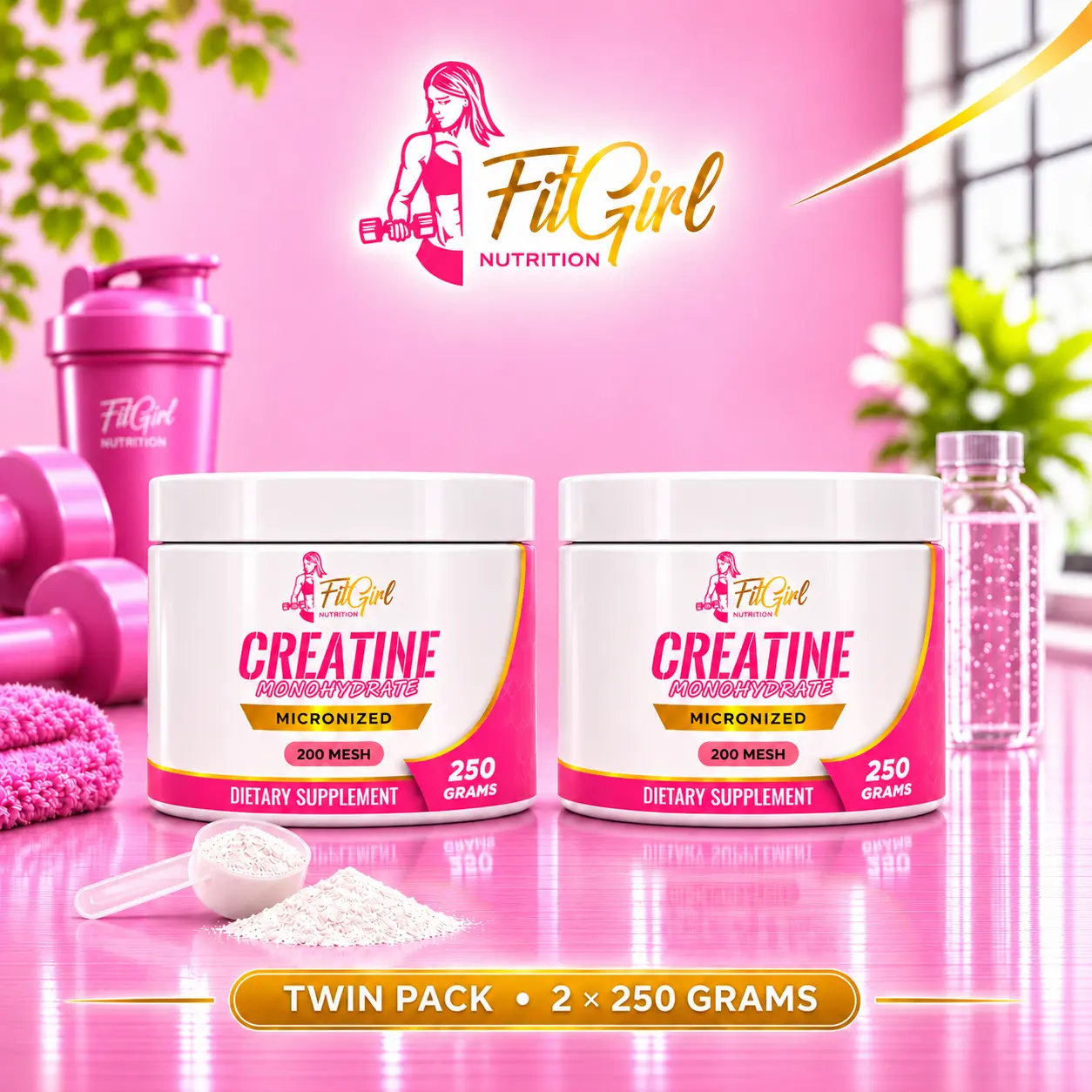
Compare amounts per daily serving, not scoop size or capsule count alone. The 200 mesh description identifies a particle-size specification, not a separate authorised benefit. [1] [2] [3]
Research & limitations
Studies differ in dose and training protocol. Findings do not establish women-specific effects or validate the dose of an ambiguously labelled capsule product. [1] [2] [3]
Approved health claims
The short-duration, high-intensity performance claim requires a daily intake of 3 g creatine and is restricted to foods targeting adults doing high-intensity exercise. Monohydrate mass must be distinguished from creatine mass. A separate older-adult resistance-training claim has different conditions and is not used here. [3] [4] [5]
Scientific references & product sources
- Kreider R.B., Jäger R., Purpura M. (2022). Bioavailability, Efficacy, Safety, and Regulatory Status of Creatine and Related Compounds: A Critical Review. Nutrients 14(5):1035 · DOI: 10.3390/nu14051035
- AlzChem / US FDA GRAS notice archive (2020). GRAS Notice 931: Creatine monohydrate — manufacturing description (not FitGirl supplier evidence)
- European Commission (2012; consolidated 2025). Regulation (EU) No 432/2012 — Annex: authorised health claims and conditions
- European Parliament and Council (2006). Regulation (EC) No 1924/2006 — Articles 5, 6, 10, 28 and Annex
- European Commission (2026). EU Register of nutrition and health claims